

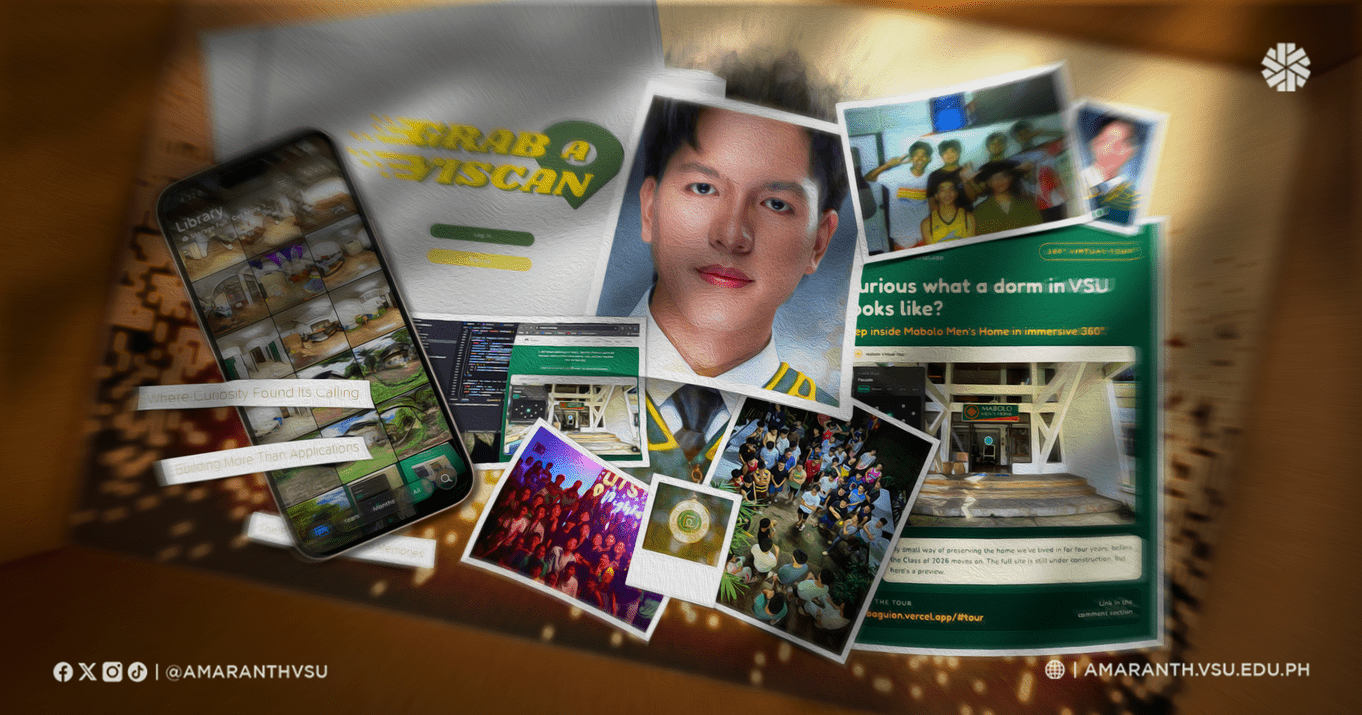
If you could preserve one moment of your life forever, what would you choose?
Doubtlessly, it would be a place that shaped you, the people who made it feel like home, or the memories that quietly became part of who you are. Perhaps that is why we create time capsules—to hold on to the memories and moments we never want time to erase. After all, memories are among the few things that only grow more valuable with time.
For Francis Mark Baguion, a Computer Science graduate of Visayas State University, the answer was clear. He chose to preserve the place that had become home not only to him but also to generations of Viscans. Rather than burying memories beneath the ground, he preserved them in pixels, creating a digital time capsule that captures not only the walls of Mabolo Men's Home but also the life that has unfolded within them. In doing so, his creative mind and innovative hands ensured that a home cherished by countless memories of Viscans could continue welcoming its people, even long after they had walked beyond its halls.
Where Curiosity Found Its Calling
Every story begins with a spark, and Baguion's began long before he entered the university. During the two years of the pandemic, while much of the world stood still, he discovered a world that constantly moved forward. Alone at home, he taught himself programming, explored website development, and spent countless hours turning curiosity into skill. What first appeared as a pastime gradually became a passion, and that passion quietly shaped the future he would eventually pursue.
“During my senior high, it was [a] pandemic, man, so for two years, I actually self-studied…sa balay lang. I started coding…creating websites already," Baguion expressed. For him, Computer Science was not merely a course choice—it was a calling he had already begun answering before college. What started as curiosity gradually grew roots, and those roots would later branch into projects that served the Viscan community.
Building More Than Applications
University life gave Baguion more than technical knowledge—it gave his skills a purpose. While many of his earliest projects started as academic requirements, they soon grew beyond deadlines and grades. He realized that every application he built could answer a real need, making technology less about innovation for its own sake and more about improving the lives of the people around him. He added, “The inspiration…why I started creating [these] mga applications or platforms…is to at least help people with the applications or platforms that we could develop as Computer Science students.”
With more freedom to explore personal ideas, he began creating projects that were not only functional but also meaningful to the community he would eventually leave behind. Among these were Grab a Viscan, a campus-based food delivery web application; VINCE, an AI-powered Virtual Information Navigator and Campus Expert for VSU Student Services; and several ongoing university-related systems.
Of all these projects, VINCE remained the most technically demanding. Baguion described it as the hardest project he had worked on, and he continues to plan integrations with multiple university websites even beyond graduation. Being his thesis output, this project was a mountain he chose to climb, each line of code another step upward, ultimately reaching the peak, a feat that led to success, as he graduated with honors.
The Project That Bottled Memories
Each innovation sharpened his skills and broadened his perspective. Yet among every line of code he had written, one project would ultimately carry the greatest sentiment—not because it was the most complex, but because it preserved something irreplaceable: the friendships that were forged within the halls of the dormitory, the conversations that went on until the break of dawn, the late-night cramming of deadlines, and every memory in between. This is what the Mabolo Virtual Tour keeps in existence.
Together with fellow Viscan developers, Baguion created a 360-degree interactive virtual tour that would allow present and future generations of Viscans to step inside Mabolo Men’s Home, no matter where they are. Accessible through a web app created by Baguion, the Mabolo Virtual Tour explores the corridors, rooms, and every surrounding area of the dormitory, including the garden, backyard, and lawn. A virtual step-through of every part of many Viscans' homes, it is interactive and lifelike, capturing every corner as it is seen and going through the entirety of the dorm with a guided map of every part.
The idea for the Mabolo Virtual Tour had been with him since the previous year, but his thesis work forced him to postpone it. Still, the thought never left him. After living in Mabolo Men’s Home for four years, he wanted to preserve the dorm exactly as he had known it before time inevitably reshaped it. He expressed, “I have been an occupant in Mabolo for four years now. So…something like a time capsule, I wanted to capture…the whole structure [and] the things inside the building, before I actually graduate.”
Capturing a Home, One Corner at a Time
The inspiration for preserving the dormitory came after a conversation with a former Mabolo dormer who wanted to revisit the dormitory but found it difficult to do so. That simple wish urged Baguion to share the essence of the dormitory, not merely as a building but as a home whose story deserved to be remembered between generations of Viscans. “I wanted to…take this chance to capture the moment and [also] use this as [a] platform for even mga senior na ning graduate na to actually…explore the current state of the building," he added.
That is how a virtual time capsule was created for Mabolo, not because people forget but because some moments are too valuable to entrust to memory alone. Baguion and his team did not just capture the structure, corners, and objects inside and outside the building but also the atmosphere that had accompanied their years as dormers and the feeling of nostalgia that is uniquely part of every experience. Like every place touched by time, Mabolo Men’s Home will continue to grow and evolve alongside the generations of students who pass through its doors; thus, the camera became a net cast against the current of time, catching details before they drifted away.
A Legacy Written by Many Hands
Going further, Baguion emphasized an important detail: that the project was never a solo achievement; it was made possible by a collaborative effort. He served as the Lead Developer, overseeing the technical architecture and implementation of the virtual tour. Dionne Maglasang worked as the UI/UX Designer, responsible for the user experience and the project’s promotional materials. The Hot Hackers of Mabolo, a group of Mabolo Computer Science students, served as the Quality Assurance team.
If the project is a time capsule, then it was buried by many hands together. Each contributor added a piece of the story, proving that preserving a home is not the responsibility of one person alone but of a community that recognizes its value. As the virtual tour of Mabolo invites people to walk through its corridors as if through a preserved moment in time, for some it is also a reminder of the bonds among the people that became the invisible architecture of the dorm. Baguion shared that the best part of being a dormer is the camaraderie that made it feel like home and the people who were once strangers but slowly became family.
The Time Capsule Left Behind
As the chapter of his college life closed, Baguion plans to explore the broader tech industry, but the projects he helped build will continue to grow within the firewall of VSU. He explained that many of their systems—including university and dormitory-related platforms—will be handed over to younger developers. “It is kind of like a continuous development." Like the dormitory itself, the projects are not ending; they are being passed from one generation to the next. As one batch writes a chapter, the next continues the story—innovation, in this sense, is less a sprint than a relay race through every generation.
In the end, Baguion’s greatest contribution may not be a single application, a thesis, or a line of code. It may be the understanding that technology can do more than solve problems—it can preserve belonging. Years from now, when today’s dormers have become alumni, they may open the Mabolo Virtual Tour and find themselves standing once again in the corridors that witnessed their youth. The walls may change, the rooms may be rearranged, and new generations of students may fill the building with different stories, but one moment in Mabolo’s history will remain carefully preserved inside a digital time capsule.
Baguion left the gates of the university with one final reminder for future Viscans like him: “Tech is constantly changing, but your passion is constant. Stay hungry, stay humble, and keep coding.” Technology will continue to evolve, but the memories it protects can remain astonishingly still through photographs, recordings, and even in a digital time capsule. Through the creative mind and innovative hands of Francis Mark Baguion, the home of Viscans has been given something rare: the chance to be remembered exactly as it once was. With Mabolo’s Time Capsule, its story will continue to live on, waiting to be rediscovered by generations yet to come.