

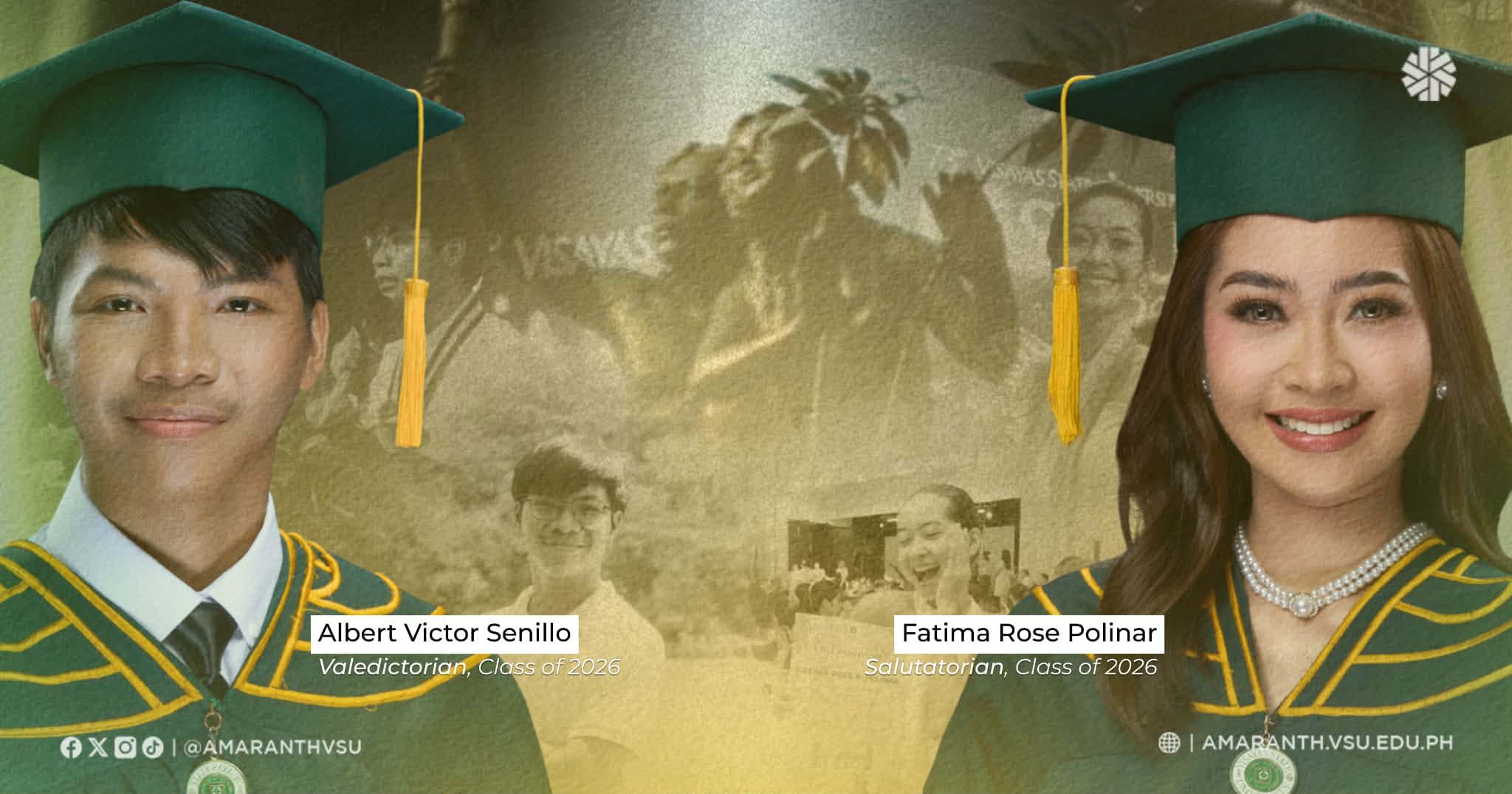
Too often, when people see the labels valedictorian and salutatorian, they focus on the bright, unassuming surface, and look away before noticing the rickety support struggling to keep the stature upright. Conclusions come in a haste: intelligence to them comes naturally. But for Visayas State University’s (VSU) 2026 class valedictorian and salutatorian, the background stories–the process that turned them into such–give a gentle, yet more meaningful, glow, but only when one chooses to notice it.
The Valedictorian that Gathered Strength
On July 21, 2026, Albert seized the podium at the Visayas State University (VSU) gymnasium for his valedictory speech. But there, on the stage, beneath blinding-white lights and with more than a thousand anticipating eyes on him, he felt the weightlessness of what can only be humility. He was overcome by a nostalgic sense of gratitude—one that made him look back and ahead, rejoicing at what lay ahead of him.
Albert Victor Senillo graduated from the Visayas State University, BS Biology Program (major in Zoology), with the highest General Weighted Average (GWA) in his class. As a resident of Baybay City, he was no stranger to the wonders of nature. Thus, upon stepping foot into VSU as a freshman student, he felt right at home.
Since the tenderness of his childhood, Albert had eyes full of wonder. A child of two professionals, he had early exposure to the power of education: being provided with books, learning materials, and various opportunities for exploration of the sciences. He often ventured into his curiosities on his own, but held a special place in his heart for all things living. In school, his biology teachers further sparked his curiosity, creating a classroom environment where biology encouraged fascination.
Yet Albert’s first program choice was not biology. It wasn’t until he discovered that VSU did not offer Psychology, and he decided to enroll in the BS Biology program. Unbeknownst to him then, however, was that he would eventually rekindle the love he had for biology from his early childhood, and that, in a domino-esque series of events, he would emboss his mark on the university because of it.
Albert’s college journey was far from the bare minimum. He was a beneficiary of the Department of Science and Technology - Junior-Level Science Scholarship (DOST-JLSS), and maintained a record of high grades that earned him the delegation of magna cum laude. He took on leadership roles, went on competitions, and, during his final years in the university, buried his nose in his research, developing a passion for it.
At some point, however, the hubbub of his academic life and the intersections of his personal one took a toll on him. By his fourth year, he was forced to sacrifice some roles to prioritize the most direct problem he had in front of him: his research.
“From the outside, it probably looked as if I had everything under control. But honestly, there were a lot of moments where I questioned if I was doing enough, or, even, if I was enough,” Albert reveals. “There came a point where I couldn’t keep carrying everything by myself, so I reached out to the Guidance and Counseling Services Office (GCSO). Looking back now, I’m really grateful I did.”
For Albert, there was strength in knowing when one needed help. In his four-year college life, he established a support system that he would find himself leaning on from time to time. His family–who he called his greatest strength–and his friends–who he “laughed with after long days”–helped him develop a sense of stability where the tides of college were stirring him from beneath his feet. Deep inside, he knew that these people’s love for him stemmed from a place beyond his awards, achievements, and successes, and instead came from the recognition of the true character within him–a quiet, ever-curious, flexibly intelligent person.
Albert discloses: “When people see the awards, or hear the word valedictorian, I hope they also remember that every achievement has a story behind it. Mine came with sleepless nights, a lot of self-doubt, and battles that only very few people saw. But if those years taught me anything, it’s that resilience isn’t about carrying everything alone. Sometimes, it’s about having the humility to let other people help carry you too.”
The Salutatorian that Left it to Faith
For Fatima, graduating as class salutatorian was not exactly the goal. She remembers it vividly: being in her third year, a week before a major thesis deadline, and feeling behind in her progress. She had come far since, down a long, bumpy road, through a tunnel she didn’t even see the light at the end of.
Fatima Rose Polinar graduated from the Visayas State University (VSU) as a BS in Biology student (major in Zoology). She came from a humble background in the municipality of Carmen, Bohol. Living close to the famous geographical landmark, she spent some parts of her childhood visiting the Chocolate Hills. She attributes this early, constant exposure to nature for her appreciation for it, which would eventually paint her future of pursuing an advocacy in environmental conservation.
Despite being in the Accountancy, Business, and Management (ABM) strand in her senior high years, she shares that her curiosity has always been rooted in the sciences. Behind that passion was the person who inspired her the most: her mother–her teacher–who went through plenty of trouble to keep food on the table and to send her and her brother to school. Witnessing her sacrifices as a child, she realized she could strive to help her family in the only way she can: being a student.
The Department of Science and Technology - Science Education Institute (DOST-SEI) undergraduate scholarship became one of those opportunities, easing the financial burden of getting into college. Reflecting on the blessings that shaped their journey, Fatima shared, “By God’s grace, He was able to make both me and my brother DOST scholars.”
Fatima recalls that her first two years in the university were rather smooth, with moments where she even excelled as one of the top-scorers in some of her quizzes then. Yet she contrasts this with her third year, where she finds herself humbled and relatively beat down. Like the rest of her class, she began her undergraduate thesis, but found herself falling short of her expectations.
She shares, “Thesis really stretched me out. It was the hardest season of my entire college journey. Sometimes I would tell myself, I don’t really see the light at the end of the tunnel anymore. I can’t see where this can end. But that journey taught me how to let go of everything I have been trying to control–to just rely, and let go, and allow God to work through the process.”
Through it all, her family and her friends were her anchor during her college days, pushing her with the unyielding faith in her and her capabilities.
She adds an intimate moment between her and her parents, “I told my parents, ‘Ma, pa, I don’t think I can graduate on time anymore.’ And they told me, ‘If it really can’t be helped, then let’s not force it.’”
Nevertheless, she persevered. Her hardships became a faint memory, yet one she continues to hold on to as a reminder of what she can achieve when she frees herself from the suffocating pressure.
One word for Fatima sums up her entire college life: ipahiluna.
“It’s a simple Bisaya word, but there’s so much peace that comes with it. Not the kind of peace that comes with having everything figured out, but the kind of peace that comes from knowing you don’t have to control everything. You just keep trusting the process, trusting God who knows what is ahead of you. Even when you don’t see the light at the end of the tunnel, remember the word: ipahiluna. That is God’s promise. Your life may not be easy but ipahiluna ra gyud ka (everything will settle into place for you).”
The lessons accidentally shared
It is thus easy for many, who watch beyond the stage, to fail to see beyond the podium where Albert and Fatima stand. It is easy to forget that they, too, carry unsaid burdens, power through unknown challenges, and stagger before difficulties they just haven’t overcome yet. But their stories are reminiscent of those who have yet to climb the crest they are on; they echo what every other student regularly goes through.
For them to succeed the way they did, they had to be familiar with the face of failure. With it, they built something more monumental than awards and wins–a character, with the ability to leave a trail of humility with every step of success; a sense of humanity, which credited their triumphs to those who completely saw their person.