

Trigger warning: This article has strong mentions of sexual harassment, violence, and other related topics that may be sensitive and may invoke strong emotional and/or mental distress. The author and editors strongly suggest you proceed with caution. Reader discretion is advised.
Sexual harassment constitutes an abuse of power, more so in the academe where power dynamics are more apparent and often encouraged, especially in meritocratic institutions like state universities. It is utilizing the imposing superiority over the inferior to advance selfish acts of a sexual nature that create an environment of hostility.
In an article in the 1995 issue of the Review of Women’s Studies, UP Professor Emerita Thelma Kintanar laid out that the problem of sexual harassment in learning institutions is grave because “the youth and immaturity of students make them highly vulnerable.” She discussed the profound respect for teachers in the Philippine context where they are perceived as persons of “learning, intelligence, and wisdom” and that they are in a “position of trust and intellectual leadership” to their students. Kintanar argues that such a position is subject to abuse.
In the academe, it may be useful to know that the law provides definition for two types of sexual harassment: Work-related and education- or training-related sexual harassment.
Definition of Sexual Harassment
The United Nations System Model Policy on Sexual Harassment defines sexual harassment as thus:
“Sexual harassment is any unwelcome conduct of a sexual nature that might reasonably be expected or be perceived to cause offense or humiliation, when such conduct interferes with work, is made a condition of employment or creates an intimidating, hostile or offensive work environment. Sexual harassment may occur in the workplace or in connection with work. While typically involving a pattern of conduct, sexual harassment may take the form of a single incident. In assessing the reasonableness of expectations or perceptions, the perspective of the person who is the target of the conduct shall be considered.”
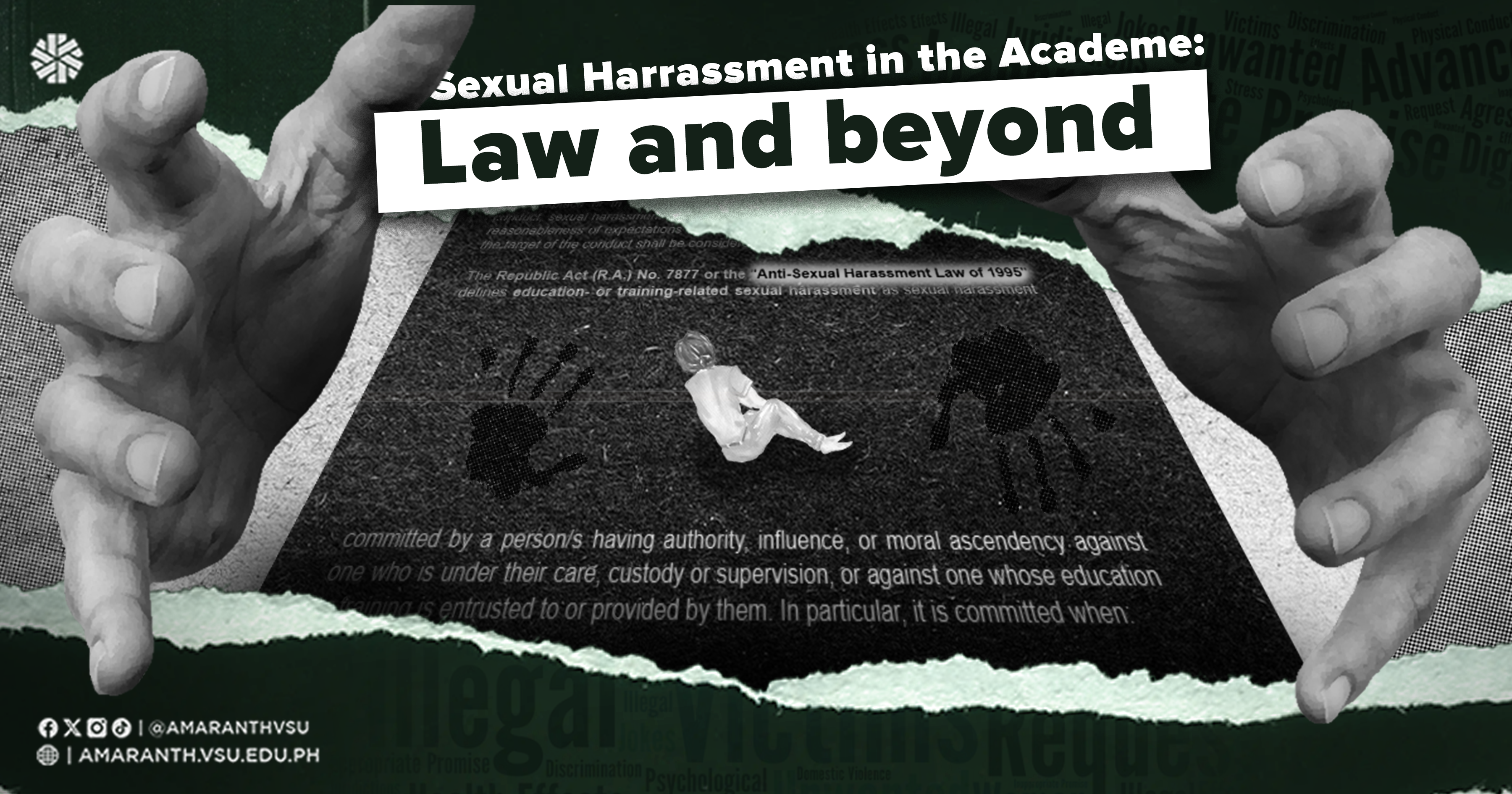
The Republic Act (R.A.) No. 7877 or the "Anti-Sexual Harassment Law of 1995" defines education- or training-related sexual harassment as sexual harassment committed by a person/s having authority, influence, or moral ascendency against one who is under their care, custody or supervision, or against one whose education or training is entrusted to or provided by them. In particular, it is committed when:
-
The offensive act is made under the condition of educational privileges, but not limited to, the giving a passing grade, merits, granting honors or scholarships the payment of a stipend or allowance, or the giving of any benefit, privilege or consideration.
-
The offensive act/s have the purpose or effect of interfering with the performance, or creating an intimidating, hostile or offensive academic environment of the complainant; or
-
The act or series of acts may cause discrimination, insecurity, discomfort, offense or humiliation to a complainant who may be a trainee, apprentice, intern, tutee or ward of the person complained of.
In the same manner, R.A. 7877 defines work-related sexual harassment as an unwelcome sexual advance, request or demand for a sexual favor, or other verbal or physical behavior of a sexual nature, committed by a government employee or official in a work-related, training or education-related environment of the person complained of. Such is committed when:
-
Submission or rejection of the offensive act constitutes the basis of any employment decision including but not limited to salary, job security benefits, and others.
-
The offensive acts have the purpose or effect of interfering with the complainant’s work performance, or creating an intimidating, hostile or offensive work environment; or
-
The act or series of acts might reasonably be expected to cause discrimination, insecurity, discomfort, offense or humiliation to a complainant who may be a co-employee, applicant, customer, or word of the person complained of.
The Safe Spaces Act (R.A. 11313) broadens the punishable acts classified as sexual harassment in addition to what was provided by R.A. 7877. This law details gender-based sexual harassment in streets and public spaces, workplaces, business establishments, public utility vehicles, and more. It seeks to include: “catcalling, wolf-whistling, unwanted invitations, misogynistic, transphobic, homophobic and sexist slurs, persistent uninvited comments or gestures on a person’s appearance, relentless requests for personal details, statement of sexual comments and suggestions, public masturbation or flashing of private parts, groping, or any advances, whether verbal or physical, that is unwanted and has threatened one’s sense of personal space and physical safety…”
R.A. 13313 categorizes four gender-based sexual harassment: (1) gender-based streets and public spaces sexual harassment; (2) gender-based online sexual harassment; (3) gender-based sexual harassment in the workplace; and, (4) gender-based sexual harassment in educational and training institutions.
The two laws are independent of each other but can also be an adjunct to each. While R.A. 7377 or the "Anti-Sexual Harassment Law of 1995” punishes those who abuse their authority, influence, and moral ascendency to sexually harass a subordinate and create an environment of hostility, the Safe Spaces Act (R.A. 11313) punishes those acts of sexual harassment based on SOGIE (sexual orientation, gender identity and/or expression)
To reiterate, sexual harassment in the context of the laws mentioned, is either/both a power issue or a gender-based issue. Either or both are punishable.
Sexual Harassment in Administrative, Civil, and Criminal aspects
Victims and complainants must know that there are various laws and jurisprudential procedures and guidelines in place that provide for tackling sexual harassment and any or combinations of these create a complex legal framework as avenues to pursue justice:
-
Civil- violations of rights and usually seeks compensation or enforcement of a right.
-
Criminal- violations of law punishable by the State filed in courts of law.
-
Administrative- complaints involving violations of professional ethics, public office conduct, or administrative rules filed with the employer, Civil Service Commission for government employees, or other professional regulatory bodies.
Justice Marvic M.V.F. Leonen in the decision for Escandor v. People wrote it impeccably, which reads:
“Sexual harassment engenders three-fold liability: Criminal, to address the wrong committed against society itself; civil, to address the private wrong against the offended party; and administrative, to protect the public service.”
Republic Act No. 7877 is a special law that provides for both criminal and administrative sanctions. Although it does not explicitly state a prescriptive period for incarceration, the correctional penalties provided for by the Revised Penal Code may apply in cases where one is absent.
In administrative cases, administrative sanctions are imposed against the public officer offender, but not limited to, suspension or dismissal from service at most. A separate civil or criminal case may be filed.
In a criminal aspect, sexual harassment is punishable by law where the penalty is either a fine, imprisonment, or both. A separate civil action can be filed by the offending party where, aside from the actual offender, the employer or the administrators of the institution may also be independently prosecuted for inaction or not taking immediate action on the complaint.
Depending on the laws or codes applied, the consequences and statutes of limitation may vary and are subject to the pertinent provisions of the same.
It is a relief that there are existing laws that provide for the acts of sexual harassment. But it is also worth mentioning that sexual harassment has only been legally defined 30 years ago after the passing of the Anti-Sexual Harassment Act of 1995 (Republic Act No. 7877) on February 14, 1995. Before that, there has been NO solid legal definition of sexual harassment nor has there been a solid legal framework that provides for the same.
Pre-RA 7877, such acts which will only then be defined as “sexual harassment” under RA 7877 in government agencies, were only covered by the Civil Service Memorandum Circular No. 19, Series of 1994 (“Policy on Sexual Harassment in the Workplace”). A criminal case could be lodged in accordance with the Revised Penal Code but is limited to: (1) unjust vexation (RPC, Section 287), or (2) acts of lasciviousness (RPC, Section 336).
The Laws as applied
In a landmark academic sexual harassment case, the Supreme Court has decided against respondent Atty. Cresencio P. Co Untian, Jr. with suspension and stern warning decision for violation of the provisions provided for by R.A. 7877 for sexually harassing three of his students.
In an initial proceeding, the Integrated Bar of the Philippines (IBP) commissioner Salvador B. Hababag wrote in his Report and Recommendation that Untian should be suspended from the practice of law for two years with stern reminders of the good moral character that lawyers should possess.
The IBP- Board of Governors affirmed Commissioner Hababag’s recommendation but resolved to disbar Untian on the grounds of gross immoral conduct. However, in an extended resolution penned by Director Ramon S. Esguerra, he explained that Untian is not guilty of sexual harassment provided in R.A. 7877 or the "Anti-Sexual Harassment Law of 1995" citing that there was no evidence that he demanded sexual favors from his students but still acknowledged that his actions were unbecoming of a law professor.
The High Court rebuked the prior conclusion of Director Esguerra that Untian’s actions were not defined as sexual harassment in RA 7877. The Court rules that the law does not require victims to accede to the sexual advances of the abuser.
“R.A. No. 7877 does not require that the victim had acceded to the sexual desires of the abuser. Further, it is not necessary that a demand or request for sexual favor is articulated categorically as it may be discerned from the acts of the offender. In addition, sexual harassment is also committed in an educational environment when sexual advances result in an intimidating, hostile, or offensive environment. In short, it is not necessary that there was an offer for sex for there to be sexual harassment as a superior's conduct with sexual underpinnings, which offends the victim or creates a hostile environment would suffice.”
In such cases where educators abuse their authority by creating an intimidating, hostile, and offensive environment, even in the absence of direct mentions of sexual advances, constitutes sexual harassment.
In his concurring opinion, Associate Justice Marvic M.V.F. Leonen put it clearly that Untian has committed sexual harassment enabled by his abuse of authority.
“Clearly, respondent abused the power and authority he possessed over the complainants. His sexually laced conduct had created a hostile and offensive environment which deeply prejudiced his students. In what was supposed to be a safe place for them to learn and develop, they were instead subjected to unwarranted sexual advances,” Leonen wrote.
Justice Leonen has lamented that the ruling acknowledges the persistence of patriarchy that when normalized, becomes encoded into society. He exacted that any more violations of this type from a law professor, “penalty should be graver.”
Sexual Harassment in the Academe
The problem of sexual harassment in the academe in the Philippines, according to Professor Kintanar, cuts across all educational levels: elementary, secondary, and tertiary. It involves people from the highest seats of learning institutions to its primary stakeholders– the students. Kintanar points out that the young are even vulnerable to the point that they are not aware that they are being sexually harassed.
Kintanar’s views concur with Justice Leonen’s bit on patriarchy as a persistent factor that tips the power scales. To wit, she bared the concept of “chancing” as an “accepted” reality among vulnerable young girls. A reality they “accept” because they are, unfortunately, a lesser power in a patriarchal society— first, because they are young; second, because they are students: and finally because they are girls. But this happens to anyone regardless, the only common denominator is that victims, at some point, have less authority, influence, or moral ascendency than the perpetrators.
Academic institutions have now established frameworks and agencies to tackle sexual harassment and have since significantly increased their campaigns against it. Anti-sexual harassment committees have been formed and guidance counselors have been incorporated into student services to address the problem. However, there are still imposing challenges within these systems and the institutions themselves, mostly involving power dynamics and bureaucracy, that make these processes limiting in achieving justice.
The fear and stigma that have been associated with victims of sexual harassment are profound factors that limps their capacities to first break their silence and report. Reporting alone is taxing physically, emotionally, and mentally. It would take a lot of courage to do so and they would have to face existing societal norms and bureaucratic pressures that put them in the limelight for something they never wished to happen to them.
The challenge now to academic institutions is to get off the high horse and work even harder so that not one more has to go through such perils.
[Author’s note: A separate article will bear the reporting framework and proceedings within the university. For a comprehensive understanding of the laws, read here.
-
RA 7877 Republic Act (R.A.) No. 7877 or the "Anti-Sexual Harassment Law of 1995" retrieved at: https://elibrary.judiciary.gov.ph/thebookshelf/showdocs/2/2826
-
Safe Spaces Act (R.A. 11313) retrieved at https://lawphil.net/statutes/repacts/ra2019/ra_11313_2019.html
-
ACT No. 3815. AN ACT REVISING THE PENAL CODE AND OTHER PENAL LAWS retrieved at https://lawphil.net/statutes/acts/act_3815_1930.html]